
Writing craft
Dialogue tags for scenes with three speakers
Keep three voices clear through attribution, paragraph changes and meaningful actions. Revise the page before judging the performance.

Dialogue tags identify the speaker without making the reader reconstruct a seating plan. That sounds simple until a third person joins, someone answers out of turn, or an action paragraph interrupts the exchange. The repair is rarely a more colorful synonym for said. It is a clear relationship between a spoken line, its owner and the surrounding action. You can build that relationship directly in your manuscript with ordinary names, paragraphs and a few purposeful movements.
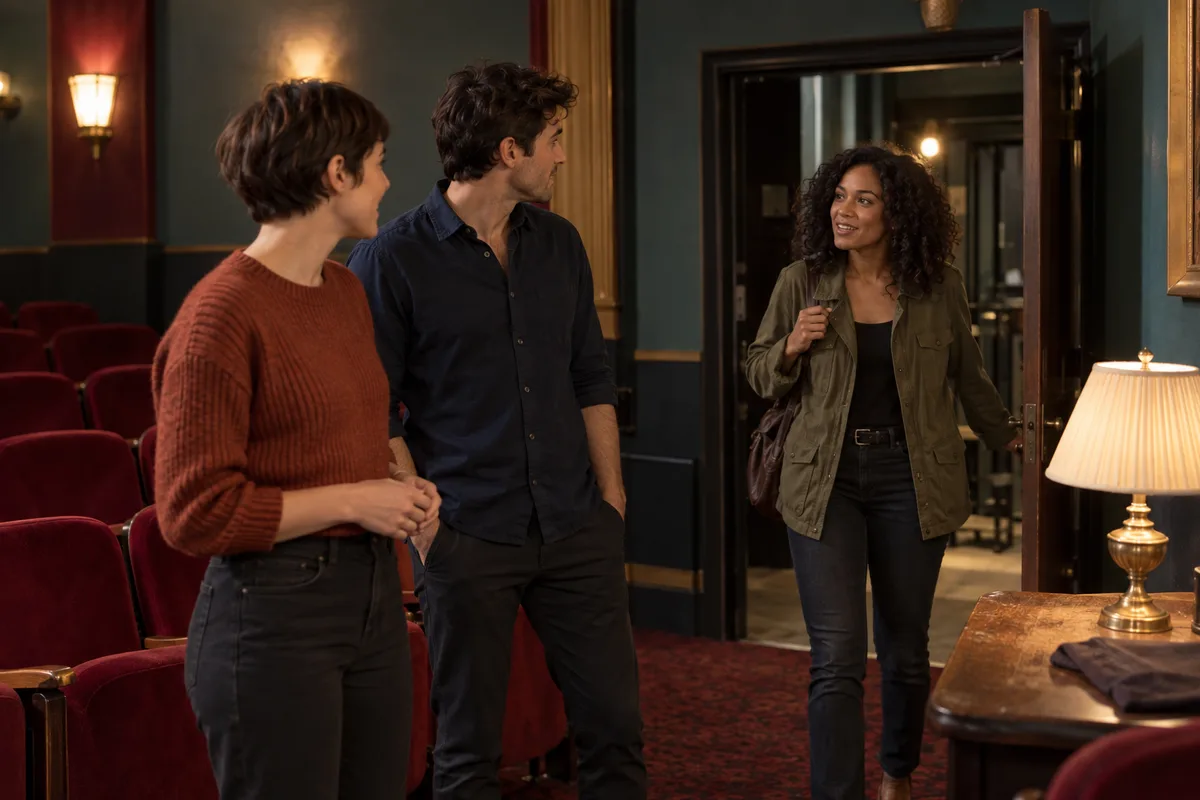
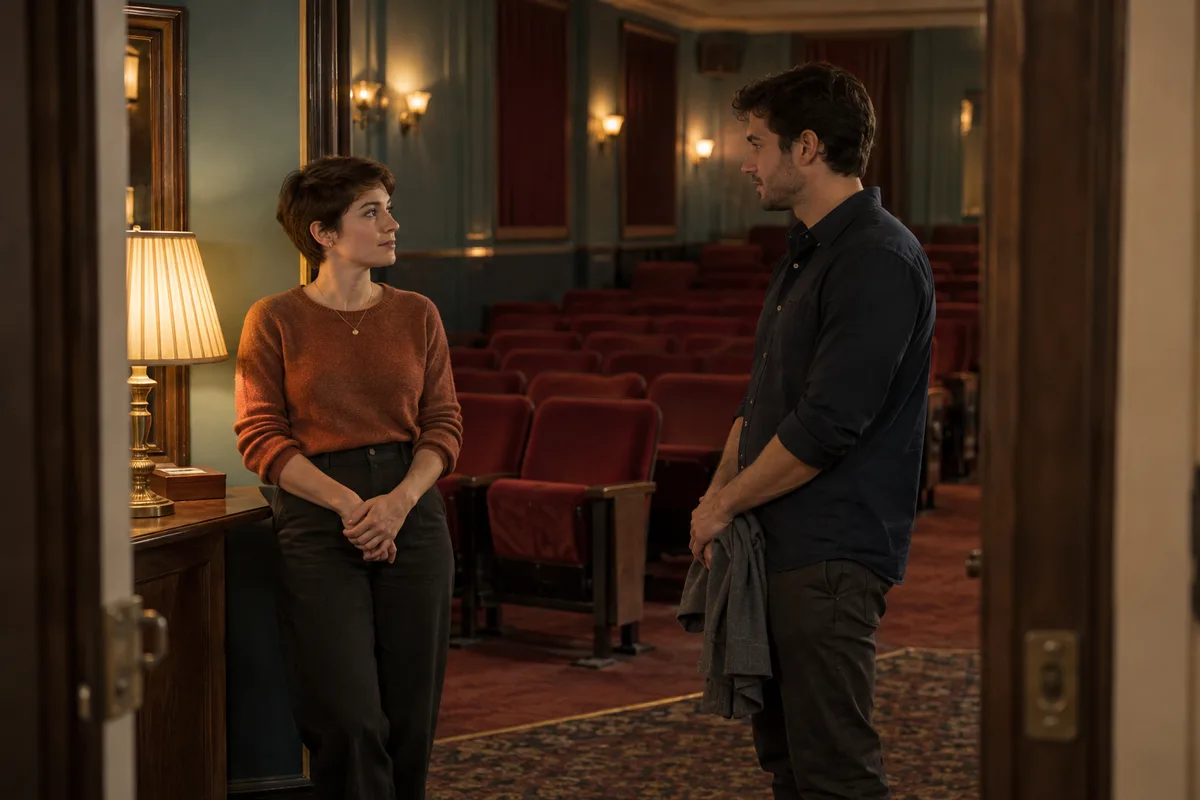
Our example takes place after a small cinema closes. Lea wants to keep a borrowed brass lamp for tomorrow’s photographs. Omar has promised to return it tonight. June comes back from the entrance with news about the collection. Their disagreement supplies a reason to speak; the revision task is to make each change of speaker easy to follow without explaining every emotion. AI Story Draft is published by Fyrlo’s developer. This guide’s method works with a manuscript and notes, independently of an app.
Dialogue tags give each line an owner
Start by separating speech from the information that attributes it. A tag such as Lea said names the speaker through a reporting verb. An action sentence such as Omar folded the cloth describes an event. Either can help a reader identify a nearby line, but they do different jobs. Putting both beside every sentence creates unnecessary competition. Ask which piece of information this particular turn needs before choosing its form.
Write a private version with a name beside every spoken line. These names are working notes, not a screenplay format you must publish. Include answers that seem obvious. Lea asks whether the lamp can stay; Omar refuses; June explains that the person collecting it has left. Now inspect your manuscript against that private list. If a reader could assign June’s information to Lea, the text needs an anchor even when you remember perfectly who meant it.
Keep the uncertainty in the disagreement, rather than in ownership of the words. A character can conceal a reason or use an ambiguous phrase while the reader still knows who spoke. Those are separate effects. For this revision, a puzzled reader should be able to ask what June means, without first having to ask whether the line belongs to June at all. Name the speaker before confusion interrupts the exchange.

Make paragraph changes do useful work
A new speaker normally gets a new paragraph in conventional prose dialogue. That boundary carries information before a tag is read. Purdue OWL’s guidance on dialogue paragraphs and quotation marks provides a useful mechanical reference. Use your chosen English publishing convention consistently; it is a starting point for presentation, rather than an instruction to make every exchange sound alike. Literary departures need to remain intelligible in the work you are writing.
Keep an action attached to the person whose turn it helps frame. Omar folds the cloth. His next line says the lamp was promised back tonight. If Lea’s protest appears in that same paragraph without a clear transition, the reader may attach her words to his movement. Give the protest its own paragraph. The paragraph is doing more than arranging white space: it keeps the action and the response from competing for ownership.
Test the passage at the scale of a phone screen as well as a full manuscript page. Paragraphs that look distinct in a wide document can become long blocks on a narrow display. Do not insert arbitrary breaks inside one person’s sentence to shorten the block. Instead, decide whether the speech needs all its clauses, and whether the surrounding description belongs there. The aim is a clear conversational unit, not a rigid maximum line length.
Put the name where recognition is needed
A name at the end of a short line usually arrives quickly enough. After a long speech, the same placement can make the reader hold an uncertain voice for several sentences. Move the attribution toward the beginning when ownership matters immediately. June’s announcement changes the disagreement, so establish June before readers interpret the announcement as another objection from Lea. The placement protects the meaning of the turn.
Compare two arrangements in your own passage without rewriting the whole conversation. In one, the name follows the final sentence. In the other, a short opening phrase is followed by the attribution before the rest of the thought. Read both once at normal speed. Choose the point at which identifying the speaker feels helpful. There is no universal requirement to put a tag after a particular number of words.
Avoid turning early attribution into a throat-clearing paragraph. A character can speak before the narrator inventories posture, clothes and mood. Give only the cue needed for that turn, then let the words carry the argument. If the reader already knows Lea is beside the table, repeating her position before each protest adds weight without information. Establishing the cast’s goals, as described on the character and plot page, can help you decide which line is theirs.
Use physical action for more than identification
An action beat earns its space when it changes the scene, reveals attention or creates a meaningful pause. Omar wrapping the lamp makes the promised return concrete. Lea resting a hand on the shade delays that task. Those movements are useful because they affect what happens between the lines. They are not interchangeable gestures inserted merely to avoid another said. The object should remain physically available after each movement.
Keep a small continuity note beside the passage: lamp on table; cloth under Omar’s hands; Lea beside the shade. Update it only when the text actually changes those facts. If the lamp is suddenly in someone’s bag, the prose must supply that movement. This simple note prevents the attempt to enliven dialogue from giving characters impossible hands or making an important object jump across the room.
An action sentence also has its own grammar. A person can say a line, but cannot fold or smile a sentence into existence. In ordinary English presentation, separate the complete physical action from the spoken words rather than treating every movement as a reporting verb. Read the result for meaning as well as punctuation. When the movement belongs to someone else, name that person and give the speaker a separate, unmistakable cue.

Reset the pattern when a third voice enters
Two people can establish a brief back-and-forth pattern. June’s return breaks that pattern. The next untagged line cannot safely be assigned by alternating Lea and Omar. Reintroduce June through a named action or a simple attribution, and clarify whom she addresses if that affects the reply. A turn toward Lea is useful when Lea responds; a glance at both people may be enough when the news concerns them together.
Do not assume the newcomer owns every subsequent line. Omar might ask a question, Lea might interrupt, and June might answer the earlier question instead. The spoken content alone may suggest an owner, but suggestion is fragile when several people want the same outcome. Keep an explicit name at the point where the pattern changes. After a short, stable exchange emerges, you can reduce cues again.
A quiet participant also needs consideration. If June has stood silently for half a page, her next line may require a name even though she never left. The reader’s attention has moved with the active conversation. Renew the anchor after an extended description, an interruption or a shift of topic. This is an attention problem, not evidence that the reader failed to memorize the cast.
Let plain verbs carry plain attribution
Said and asked can identify a turn without announcing an interpretation. That makes them useful when the words and circumstances already communicate the pressure. Lea’s request becomes insistent through what she keeps asking for, not through a series of increasingly forceful reporting verbs. Use a more specific speech verb when it supplies information the line cannot supply, such as an audible whisper that matters because someone nearby must not hear.
Avoid a quota for plain tags, expressive tags or action beats. A fast disagreement and a slow negotiation need different rhythms. Replacing every said with a movement can make the cast perform a restless sequence of small gestures. Replacing every movement with said can remove the practical conflict around the lamp. Read the passage for the effect of the choices, rather than counting varieties as though variety were the goal.
Also question adverbs that repeat an already obvious tone. If Omar gives a blunt refusal while folding the cloth for departure, an added impatiently may explain what the reader has already seen. If his politeness hides an unexpected urgency, a carefully chosen cue may matter. Remove one cue at a time and compare the meaning. A useful detail survives because of its contribution, not because a blanket rule permits or forbids it.
Separate the clarity pass from the performance pass
Make one revision pass that checks only speaker ownership. Mark the first line where you hesitate, add or move the smallest useful anchor, then read forward again. Keep the dialogue’s actual wording unchanged during this pass. Otherwise, improvements to a joke or argument may conceal the attribution problem rather than solve it. Once the ownership is stable, a second pass can address pace and voice.
Read the spoken lines aloud with a partner or in different positions around the room. This can expose a response that arrives too late or sounds like the wrong person’s concern. Then return to the written page: a performance supplies voices and gestures that a reader will not receive. A passage that works beautifully aloud may still need a name when those external cues disappear.
If you use Fyrlo while revising chapter continuation, retain the accepted speakers, object positions and outcome in the context you provide, and review the resulting draft yourself. The chapter continuation page explains that workflow. The app is a drafting aid; it does not guarantee correct attribution, physical continuity or publication readiness. The manuscript test remains necessary even when generated prose sounds fluent.
Check the exchange with a fresh reader
Give a reader the scene without your private speaker list. Ask them to identify the speaker at two deliberately chosen points: June’s return and the first line after a long action passage. Ask what textual clue supported the answer. A correct guess based on the expected personality is weaker evidence than recognition based on a name, paragraph or clearly owned action. You want the page to carry the information.
If the answer differs from your intention, resist explaining the scene aloud. Write down where the reader’s understanding changed. Repair that point, then check the surrounding paragraph for a new collision between action and speech. More tags throughout the whole scene may obscure the rhythm without addressing the actual gap. A local correction is easier to evaluate because you can see what it changed.
Finish by reading the scene without the private list, preferably after a break. Confirm the cast’s positions, the owner of each spoken turn and the practical result: who now decides what happens to the lamp? Remove any attribution that merely repeats a secure cue, but keep a clear name wherever the conversation changes direction. The finished dialogue should leave room for interpretation while making its speakers available to the reader.
Good to know
Questions and answers
Must every line have a dialogue tag?
No. Keep a cue wherever ownership could become uncertain; remove genuinely redundant attribution.
Can an action replace a speech tag?
It can identify the nearby speaker, but remains a separate action with its own grammar.
Does reading aloud prove attribution is clear?
No. Performance supplies voices; check the written passage without those extra cues.