
Dialogue and necessary information
Give exposition in dialogue a purpose
Give an explanation a listener, a present reason and a practical result. Plan a focused exchange and compare one alternative without changing the facts.
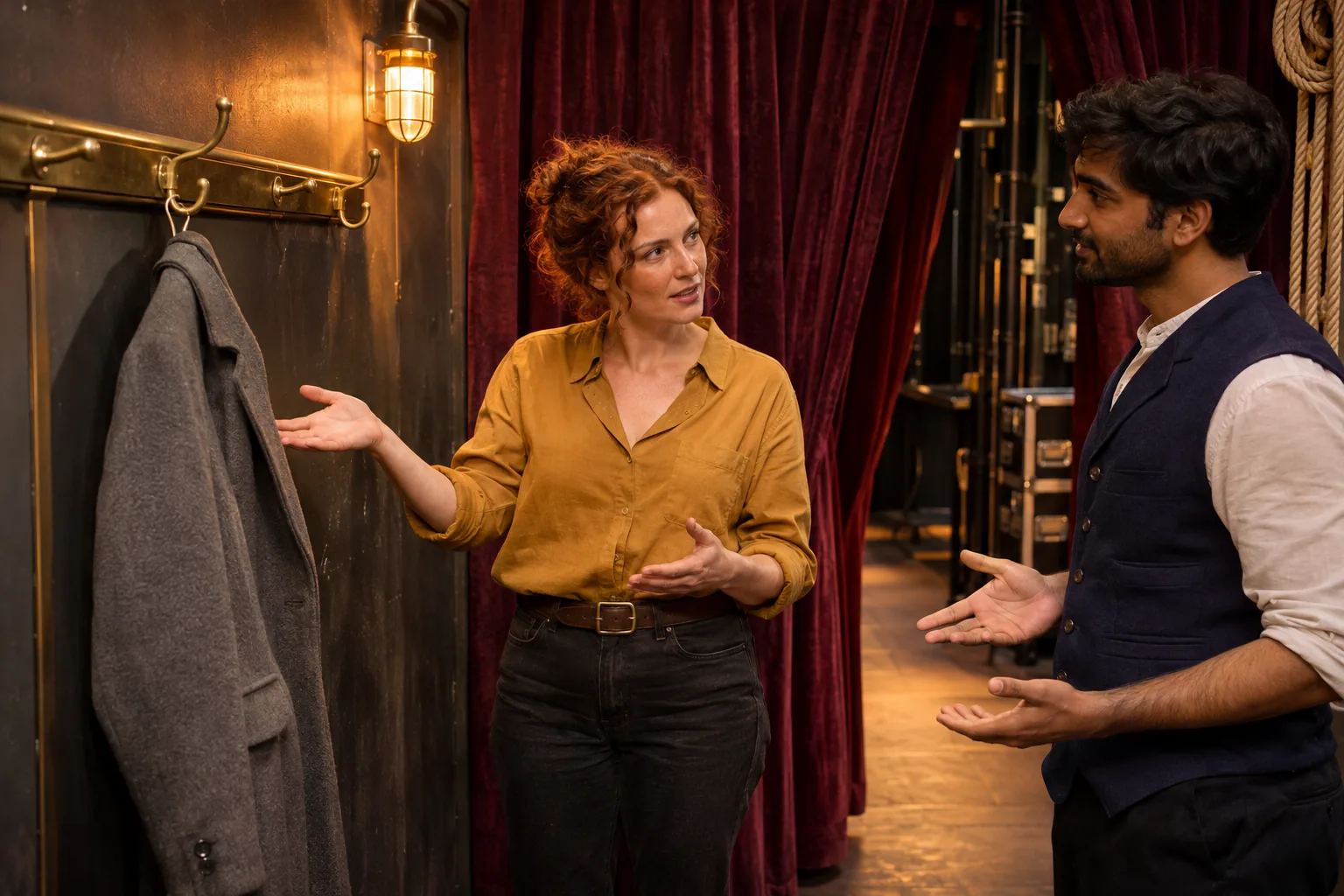
A character opens their mouth and explains the family history, the local rules and the reason a coat hangs beside a curtain. The reader learns plenty, but the person listening has nothing to do except wait. Exposition in dialogue becomes difficult when the conversation exists mainly to deliver the author's notes. The repair starts with a smaller question: why does this person need to say this fact now?
Our example takes place in a theater wardrobe alcove. Celia has prepared a gray coat for Mae's entrance. Arun, helping backstage for the first time, begins to move it elsewhere. Celia needs to stop that action and explain enough for him to help. You can develop the exchange manually, then use Fyrlo to plan a limited draft, compare one alternative and continue from the version you accept.
Give exposition in dialogue one immediate job
Choose the single fact that changes the next action. Here, Mae needs the gray coat before entering the stage, so it must remain on the nearby hook. That is enough to explain why Celia speaks. The entire history of the theater, Mae's career and the coat's previous owner may interest you, but none is automatically needed to decide where Arun puts it.
In his Center for Fiction craft essay, novelist Teddy Wayne advises giving dialogue purposes beyond the delivery of information. We use that principle as a starting point, with an original backstage exercise. The useful result is modest: the listener can respond to what was said. A factual sentence does not have to hide a secret or start a quarrel to belong in a story.
Write your chosen fact outside the scene in plain language. Then write the action it should affect. If you cannot connect the two, consider moving the fact into narration or saving it for another moment. Do not invent an emergency to force the connection. A coat left within reach for an ordinary entrance gives the characters a practical reason to exchange information without turning routine preparation into a crisis.
Check what the listener already knows
Arun knows he has been asked to help clear the alcove. He does not yet know that the gray coat is part of the next entrance. Celia knows its purpose but may not realize how broad her earlier instruction sounded. This small difference gives the conversation a foundation. Neither person needs to behave foolishly, and the narrator does not need to announce a hidden conflict between them.
If both people already know a fact, that does not automatically forbid saying it. A reminder can be appropriate before a task. Celia might say that the coat stays here because she sees Arun reaching for it. What feels unnecessary is a speech explaining everything they both know without a present reason. Test the occasion for speaking, rather than banning every reminder as artificial exposition.
Our guide to multiple points of view explains how to separate character knowledge from the writer's complete plan. You can use the same distinction in a single-viewpoint scene. If you follow Arun, he can interpret Celia's tone, but he cannot narrate her private intention as fact. The audience's need for background does not give either character knowledge they have never acquired through the story.

Build a compact premise and scene plan in Fyrlo
Start your Fyrlo work with the practical premise: two adult backstage helpers need to prepare an alcove before a performance. Record that the hook is beside the curtain, the coat is required for Mae's entrance and Arun has understood “clear the alcove” more broadly than Celia intended. Keep these character and plot facts together in your working context so that a draft has a stable problem to address.
Plan four movements: Arun starts to move the coat; Celia stops him; he asks or responds; they settle what stays and what can move. Mark other ideas as possibilities, not accepted history. You might later decide that Celia is impatient or that Arun dislikes being corrected. Neither trait is required to make this exchange work. Do not ask a generated continuation to treat every brainstorming possibility as an established fact.
Fyrlo can assist with premise, planning and chapter-by-chapter drafting, but it does not certify what information a reader needs. Check which functions and usage limits are available in your current version, and retain your own accepted notes. The app is free to download; some features or usage may require in-app purchases. Do not assume unlimited generation or that every version offers the same access.
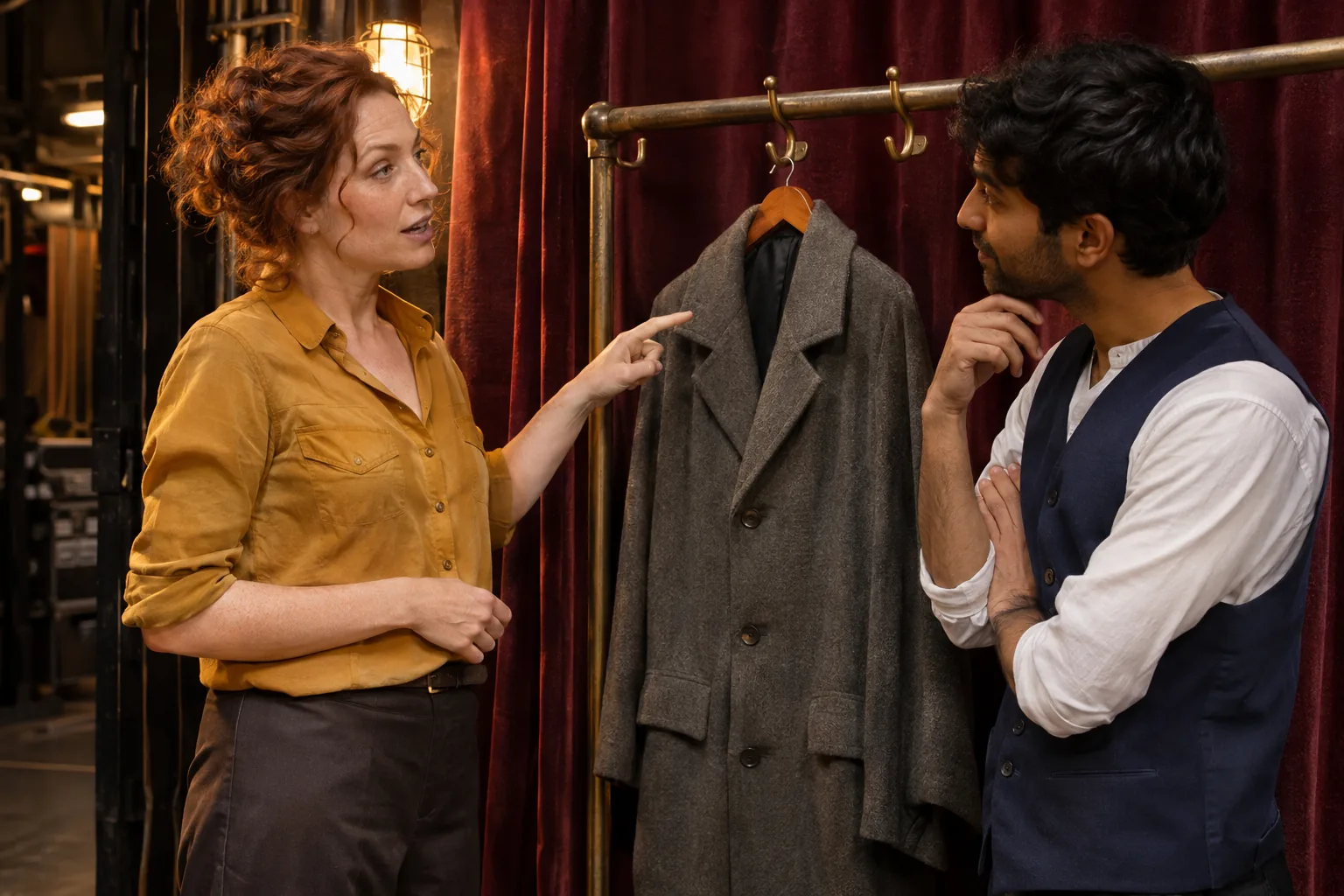
Draft the explanation as an attempt to do something
Write a bounded passage of roughly three hundred words, stopping after Arun's response and one resulting action. A useful instruction asks for the established scene, one necessary explanation about the coat and a visible consequence. Keep the narrative person and tense fixed. Ask the passage to avoid adding a rehearsal accident, a missing costume or a last-minute rule merely to make the conversation more dramatic.
A plain starting point is Celia saying, “Leave that one here. Mae needs it before she goes on.” Arun could ask whether the other coats can move. The second line matters because it turns the explanation into a revised working arrangement. He is not simply confirming that he heard. He uses the information to clarify the task he was already trying to perform.
Now read the exchange without the surrounding descriptive sentences. Can you name what Celia is trying to obtain and how Arun responds? If the lines only list facts, give the listener a relevant decision. You do not need a clever retort. A request to distinguish this coat from the others may do more for the scene than a polished speech about the theater's traditions.
Compare one alternative without changing the rule
Select one uncertainty in the first draft. Perhaps Celia's explanation is clear but sounds like a lecture. Ask for one alternative that preserves the same coat, hook, entrance and instructions while shortening or redistributing her speech. Keep the stopping point similar. You are comparing the handling of exposition, not inviting a different plot that solves the problem by making the information more sensational.
Check both versions against the plan. Does the listener have a reason to need the information? Does the explanation address the task? Does a response change what happens next? If an alternative invents a previous mistake by Arun, it has changed the relationship, not merely improved the wording. Accept that only if you deliberately want to revise the wider story and account for the new history afterward.
Choose or rewrite the useful lines yourself. Our guide to reviewing AI dialogue offers a broader check of facts, responses and manageable revision; here the narrower task is whether the explanation earns its place. Generated text can sound confident while altering established details. Check continuity, originality and accuracy yourself. Drafting assistance does not guarantee quality, copyright status or that a manuscript is ready for publication.

Put reader-only background where it belongs
Some information matters to the reader without needing to be spoken. Arun might notice that the brass hook is the only empty space along a crowded rail once he lifts the coat. That observation can explain why he chose it without making him tell Celia what she can already see. Narration and dialogue can divide the work, rather than compete to carry the entire background.
Try moving one explanatory sentence out of speech. Keep it within the chosen perspective and make sure it adds something useful. A brief statement that Arun had been sent to clear the alcove may be enough. A paragraph describing every earlier task would stop the scene for a different kind of information dump. The solution is not simply to transfer the whole lecture from quotation marks into narration.
You can also postpone a fact. If Mae's identity does not matter beyond her upcoming entrance, her biography can wait. Readers can follow a local action before learning every relationship in the production. Check that postponement preserves basic comprehension: who is acting, which object matters and what the immediate instruction changes. Withholding those anchors is more confusing than leaving a genuinely secondary detail unexplained.

Let the listener test the explanation
Arun might accept that the gray coat stays but ask which items Celia meant him to clear. Celia then points to the spare hangers. The original instruction becomes more precise, and the scene produces a new action. This response keeps Arun engaged without turning him into a person who objects to every sentence. Cooperation can expose the gap between two understandings as effectively as disagreement.
Alternatively, he could misunderstand the explanation and place the coat on a different nearby hook. If you choose that version, show why the distinction matters and how Celia clarifies it. Do not punish him for a detail the draft never established. A reader should be able to see where his interpretation came from. Otherwise the correction seems designed to demonstrate the author's control rather than reveal a believable exchange.
Keep the response proportionate. A practical mistake does not automatically reveal deep resentment, hidden rivalry or a transformed relationship. Those developments need their own evidence. For this exercise, it is enough that Arun now understands what to leave within reach. The dialogue has supplied information and changed the task. You can decide later whether the exchange also contributes to a larger relationship pattern.
Continue from the information they accepted
Before writing another chapter, record the accepted outcome. The coat remains on its original hook; Arun moves the spare hangers; both know which preparation task takes priority. Keep discarded alternatives outside the continuation context. If one version moved the coat and another left it alone, a later passage must not treat both as events. Clear notes prevent an attractive draft from introducing contradictory physical history.
Continue chapter by chapter in Fyrlo from those accepted facts, asking for the next limited situation rather than a complete explanation of every character. Mae's arrival could test whether the coat is accessible. It does not have to include a speech praising the lesson Arun learned. Let the consequence be visible through ordinary action, and review any new details before adding them to your story's established context.
Finish by reading the dialogue aloud once for purpose and once for flow. Ask which fact the listener receives, why the speaker raises it now and what changes afterward. Cut the information that serves none of those needs, or give it a more appropriate place. Useful exposition does not disappear. It reaches the reader through a conversation that the people in the scene have a reason to conduct.
Good to know
Questions and answers
Is explanatory dialogue always a mistake?
No. People explain, teach, remind and correct one another for practical reasons. Look for a listener who needs the information, a speaker with a reason to provide it and a response that belongs to the situation. The problem is usually the missing occasion for the explanation, not the mere presence of facts in speech.
Should I add a newcomer so someone can explain the setting?
Only if that person's role also serves the story. A newcomer can legitimately need information, but should have a task and a response beyond asking questions for the reader. In this exercise Arun already has work to do. His misunderstanding affects that work, which gives the explanation an immediate purpose.
How long can an explanation be?
There is no universal sentence limit. Consider what the listener needs now and whether the exchange remains active. A longer explanation may fit a teaching scene, while a short reminder can be excessive when both people have no reason to repeat it. Compare a bounded passage and judge its actual effect rather than counting lines alone.