
Narrative time
Past or present? Choose your narrative tense
Choose a base tense, compare one passage and preserve earlier facts, dialogue and expected events as you continue the chapter.

Narrative tense becomes a practical problem when a draft begins with “Nadia spread the cloth” and continues with “Mateo carries the blue bundle.” If both actions belong to the same afternoon, the reader has to decide whether the story has moved in time or the wording has slipped. A request to make the scene more vivid can introduce that uncertainty when you revise with an AI writing aid.
Start by deciding where the narration stands. Past and present can both support a quiet scene, an argument or a discovery. Neither choice guarantees urgency, literary quality or reader interest. This guide uses one original textile studio scene to make a bounded choice, test an alternative in Fyrlo and check the accepted continuation yourself. You can also do every comparison in an ordinary document.
Narrative tense begins with the main action
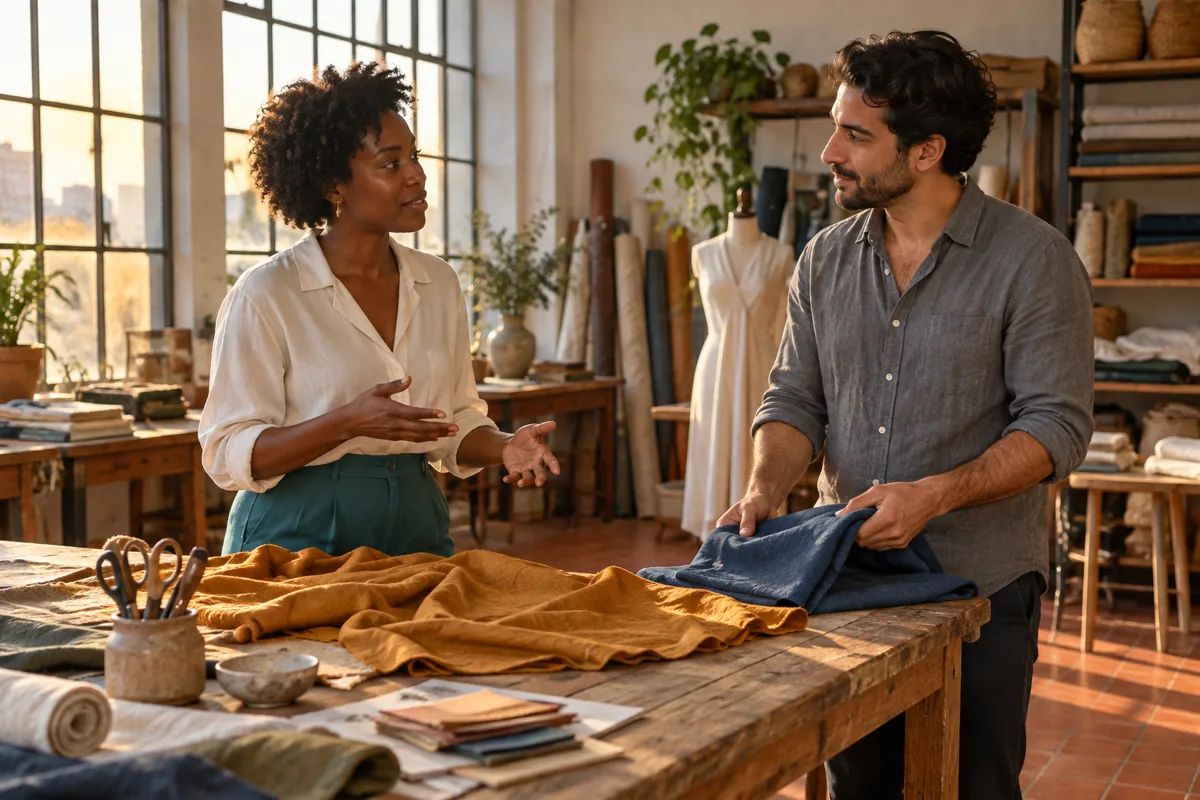
Nadia is setting aside ochre fabric for Clara. Mateo is gathering a separate blue bundle at the other end of the cutting table. He placed that bundle there earlier in the morning. Clara will collect the ochre fabric the following day. These are the working facts, not a finished opening. They identify the current task, something already completed and an expected later event.
Purdue OWL’s English grammar guidance distinguishes a primary tense from justified changes that express different time relationships. That narrow distinction supports this revision. Our studio, characters and comparison method are original. The guidance does not establish that one tense produces better fiction, and it does not assess Fyrlo or promise that generated prose will be consistent.
Choose a short passage containing the actual difficulty. A whole chapter can hide the reason a particular verb changes. Here, use the moment Nadia spreads the fabric, asks about Clara and hears Mateo answer. Keep the earlier delivery and tomorrow’s collection available as context. You now have a manageable passage in which each time reference can earn its place.

Give the premise a provisional plan
Before requesting prose in Fyrlo, establish the premise in plain language: Nadia needs to keep Clara’s ochre fabric separate while Mateo clears his blue bundle. The scene ends when Nadia folds the reserved length. This gives the passage a concrete task and an endpoint. The app can support planning and drafting around that premise; the choices about what belongs in the story remain yours.
Shape a brief plan with three movements: spread the ochre fabric, clarify the collection arrangement, fold the reserved length. Keep it provisional. You do not need to generate a complete novel outline to solve this paragraph. If a proposed plan adds a damaged delivery or a conflict about ownership, decide whether you want that development before allowing it into the draft.
The same preparation belongs in your character and plot context. Nadia knows Clara’s request; Mateo knows when the collection is expected. Neither needs secret knowledge of an event that has not happened. Record those accepted facts beside the scene plan. Maintaining them helps you distinguish a tense revision from a new version that has quietly changed the situation.
Draft one base version in the past
Try a plain past version: “Nadia spread the ochre cloth across the table. Mateo lifted the blue bundle. He had left it there that morning.” The first two sentences carry the main scene. The third places a completed action earlier than that scene. Its different verb form has a reason; consistency does not require every verb to look identical.
Read the whole paragraph around these sentences. A narrator may report an ongoing activity while another action occurs. You therefore need to understand the relationship before editing an individual ending. Identify what Nadia does at the scene’s current moment, what was already true and what is merely expected. If you cannot explain a shift in those terms, mark it for review.
When asking Fyrlo for a candidate, specify the base tense, viewpoint, facts and short endpoint. For example, request past narration following Nadia as she reserves the fabric, with the blue bundle already delivered that morning. Review the result before adding it to the manuscript. A plausible sentence can still change the delivery time, the speaker or the person holding the fabric.

Compare a present version with the same facts
Save the past candidate before testing present narration. A focused alternative might begin: “Nadia spreads the ochre cloth across the table. Mateo lifts the blue bundle. He left it there that morning.” The delivery still precedes the main action. The simple past in that final sentence is compatible with this present scene because the time reference is explicitly earlier.
Ask for one alternative of the same passage, preserving its action order, viewpoint and information. This is a writing request, not a claim that Fyrlo has a dedicated tense conversion control or an automatic consistency score. Inspect what the response actually does. If it invents scissors, an appointment or a dispute to make the passage lively, remove those additions or explore them separately.
Compare the candidates against specific needs. Does each allow Nadia to notice the blue bundle before Mateo removes it? Does either narrator sound more reflective than the surrounding chapter? Read the paragraph immediately before and after each version. You are choosing a local fit for an established voice. There is no need to declare one tense more immersive for every reader or genre.
Let dialogue use its own time reference
Suppose Mateo says, “Clara will collect it tomorrow.” That future form can remain inside a scene narrated in the past. It belongs to Mateo’s speech at that afternoon’s moment. Changing it mechanically to “would collect” inside the quotation would alter the way the line is spoken. Review quoted words separately from the reporting narration around them.
An indirect report needs its own treatment: “Mateo said Clara would collect it the next day.” The expression locates the expected collection relative to the past conversation. These examples offer two ways to handle our arrangement; they are not interchangeable instructions for every sentence. Meaning, the narrator’s position and what remains true in context all affect a useful choice.
Check pronouns and time words along with verbs. “Tomorrow” in direct speech has a clear speaker’s reference point. In a distant retrospective narration, “the next day” may orient the reader more clearly. Do not run a global replacement that changes all occurrences indiscriminately. A letter, a quoted message or a character’s spoken promise may need to retain its original wording.
Review exceptions without erasing their meaning
Make a small review list outside the manuscript. For each marked verb, note its actor, the relevant moment and the reason for its form. The earlier placement of the blue bundle belongs before the fabric is spread. Clara’s expected collection belongs later. Nadia’s current handling of the ochre length belongs to the main scene. This is an editorial aid, not another passage readers must see.
Inspect general statements too. A narrator might describe a regular working habit or something still true at the time of telling. Such a sentence can operate differently from a completed action in the scene. Keep it only if the voice and context justify it. Avoid adding a timeless pronouncement merely to explain an accidental present verb in an otherwise past paragraph.
Use another reader when your own knowledge fills the gaps. Ask when Mateo placed the bundle and when Clara is expected, without first explaining your intention. Their answer can reveal uncertainty that a grammatical sentence has left unresolved. It is feedback about this passage, not a scientific measure of immersion or proof that a particular tense always works better.
Accept one version and continue chapter by chapter
Choose the version that fits the chapter and update the working plan and accepted character context accordingly. Keep the main narration in the chosen tense while allowing justified references to earlier or later events. Carry a brief note into the next drafting request: Nadia has folded Clara’s ochre fabric; Mateo is clearing the blue bundle; collection remains expected, not completed.
Continue with the next relevant action rather than regenerating the entire chapter to fix one slip. If you use Fyrlo, give it the accepted passage and that concise context, then request a limited continuation. Check the first new paragraph against the last accepted one. The app’s planning and chapter drafting support can assist the process, but it does not remove the need to inspect the text you keep.
When a continuation changes tense without a new temporal reason, revise that location and reread the join. Also check that Clara has not arrived prematurely and that the reserved fabric remains available. A correct verb ending cannot repair a changed event. Record your decision in practical language: past base, earlier delivery clearly marked, spoken future preserved, collection still pending.

Finish with a deliberate consistency pass
Set aside the alternative once you have made the choice. Reading two versions at once can encourage small phrases to migrate into the accepted paragraph. Work from a single manuscript and compare its opening, middle and continuation. Preserve deliberate shifts that carry meaning. Repair unexplained changes where the action remains in the same temporal frame, then remove your temporary review notes.
AI Story Draft is published by Fyrlo’s developer. Fyrlo is free to download; features or usage may require in-app purchases. This guide describes a bounded planning and drafting workflow, not a guarantee of grammatical accuracy, originality, factual reliability, quality or publication readiness. Keep copies of accepted writing and review generated suggestions before incorporating them into a chapter.
Your final test is simple enough to repeat: identify the scene’s main action, locate earlier facts, inspect speech and expected events, then read forward into the next paragraph. If those relationships remain understandable and the voice belongs to the chapter, the tense choice has a usable foundation. Stop polishing this isolated passage when it is clear enough to support the story’s next action.
Good to know
Questions and answers
Must every verb use the same tense?
No. Establish a base for the main scene and preserve justified references to earlier or later events.
Can dialogue use a future form inside past narration?
Yes. A speaker can refer to their own future. Check the reporting narration and time expressions separately.
Does Fyrlo guarantee tense consistency?
No. Review generated passages yourself, preserving accepted story facts and the chapter’s voice.