
Theme and story planning
Theme in fiction: a question inside a choice
Develop a thematic question through a practical decision, compare one focused alternative and continue from the consequence you choose.

A draft can contain a striking incident and still leave you unsure what it is exploring. You may know who enters the room, what goes wrong and how the scene ends. Yet when you try to explain the theme in fiction, you produce either a plot summary or a sentence that sounds like advice. Neither tells you what to revise next.
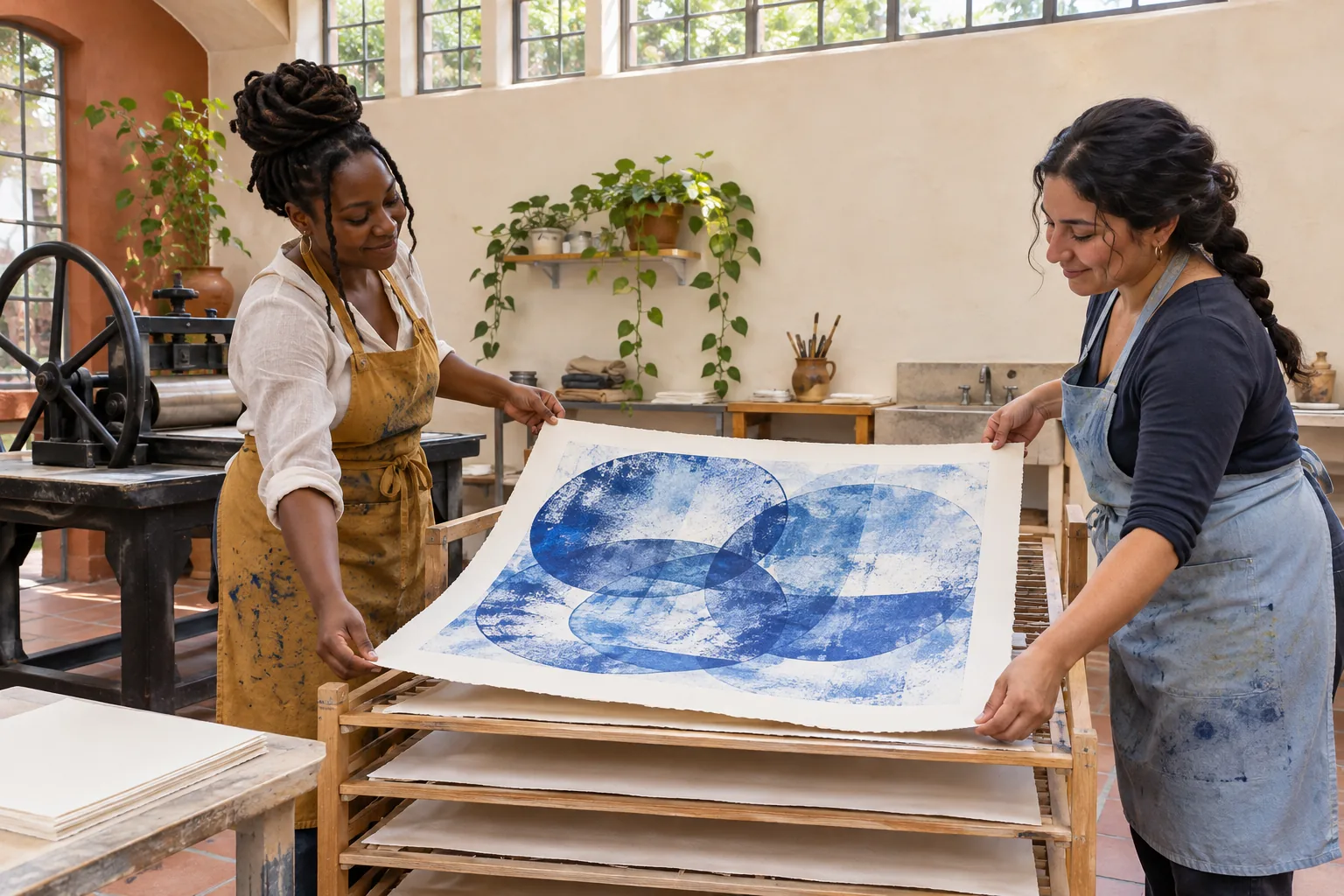
This exercise starts with an ordinary decision in a print studio. Imani and Rosa have made a print together. A visitor is coming to collect it, but only Imani was contacted. Who will present the work, and how will each woman describe the other's contribution? You can develop that question manually, then use Fyrlo to organize context and compare a limited passage. The writer still chooses the meaning, checks every suggestion and decides what becomes part of the story.
Theme in fiction starts with a question
A subject gives you an area to explore: credit, belonging, loyalty or ambition. A plot summary tells you what happens. A thematic question asks what those events reveal about the subject. For this example, the subject is shared credit. The plot involves delivering a print. The question is whether recognition can be shared when the opportunity arrives through only one collaborator.
Oregon State University's literary guide distinguishes a story's deeper concern from a simple instruction about how to live. That distinction is useful here: you can explore a question without attaching a moral to the final paragraph. The practical method below is our own writing exercise, rather than an example taken from the university's lesson.
Write three separate notes before you draft. First describe the task in the room. Then name the larger concern. Finally turn that concern into a question that the characters could answer differently. If your question can be resolved without anyone acting, make it more specific. “Is fairness good?” is too broad. “Does sharing the presentation also require sharing control of the explanation?” gives the scene something to test.
Give both possible answers a real cost
Imani could present the print alone and name Rosa's contribution accurately. She could also wait and ask Rosa to present alongside her. The first option may preserve the arrangement with the visitor while leaving Rosa represented by someone else. The second may recognize their partnership while making an already awkward meeting harder to organize. Neither option has to be secretly perfect.
Give Rosa a position that does not merely confirm the author's preferred answer. Perhaps she dislikes public presentation but wants to describe the printing process herself. Perhaps she is happy for Imani to speak, provided the visitor does not treat her as an assistant. Decide which version belongs to this story. Do not use all possibilities at once or change Rosa's wishes whenever the argument needs a new obstacle.
Now identify what each woman can observe. Imani knows who received the invitation; Rosa knows which parts of the print required her judgment. Neither can read the other's private reasons. Let a question, a pause or an interrupted task expose that gap. A theme gains force when the reader sees why an apparently considerate choice can still leave something unresolved.

Put the premise and plan into usable context
In Fyrlo, begin with a compact premise and a plan for the next piece of writing. State that two adult collaborators must prepare a jointly made print for collection. Record the visitor's arrival as a practical constraint, not a countdown inserted to manufacture danger. Name shared recognition as the question you want to explore, while leaving the characters free to disagree about its expression.
Keep character information and plot facts together in your working context. Imani arranged the collection; Rosa helped develop and print the image; neither has agreed who will explain the process. Distinguish those established facts from ideas still under consideration. A possible resentment is not yet a fact. A suggested line of dialogue is not something the character has already said.
Your plan can remain short: finish handling the print, raise the presentation question, make one decision, then show an immediate response. Fyrlo can support planning and drafting, but it does not certify what your scene means. Check the available features in your current version, and keep your own accepted notes. The app is free to download; features or usage may require in-app purchases. Do not assume unlimited generation or identical access in every version.

Draft a choice that changes the task
Write a bounded passage of roughly three hundred words, stopping shortly after the decision. A useful instruction is: continue the print-studio scene using the established facts; let Imani propose who presents the work; let Rosa respond through speech and action; avoid a narrator's explanation of the lesson. This defines the task without asking the draft to prove that one character is morally correct.
For example, Imani might move the print toward the drying rack and say that she can describe Rosa's process to the visitor. Rosa keeps hold of the other edge and asks which process she means. The sheet still needs support. Their disagreement therefore changes the way a practical task proceeds, rather than becoming an essay detached from the room.
Do not mistake an attractive gesture for a complete scene. If Imani offers to share the presentation, show whether Rosa accepts, asks for something different or postpones the conversation. If the text ends before that response, you have an intention without a consequence. Continue only far enough to discover what the choice actually changes between them.
Compare one alternative with the facts fixed
After reading the first passage, select one uncertainty. Perhaps Imani's proposal sounds controlling even though you wanted it to be clumsy but considerate. Ask for one alternative that changes the proposal while preserving the setting, the collaboration and Rosa's established preferences. Keep the length and stopping point similar so that you can compare the same dramatic moment.
Read the passages beside your plan, not as a competition for the prettiest wording. Mark where each version makes a decision, who has room to respond and what practical consequence follows. If an alternative invents a prior argument or makes the visitor demand a sole creator, reject that addition unless you deliberately want to revise the larger story. New facts can make a weak passage seem persuasive by changing the problem.
Choose or rewrite individual lines only after you understand their effect. You might retain the first version's handling of the sheet and the second version's more open question. Record the resulting passage as the accepted continuation. Keep discarded alternatives out of subsequent context, otherwise later drafting may treat incompatible events as if both occurred. No automated score can replace that editorial choice.

Let the other character complicate the answer
A cooperative response does not have to settle the question. Rosa could agree to present together but ask Imani to introduce the work without explaining who deserves which share. Imani may have expected a clear division of credit. The agreement then opens a more precise difficulty: does recognition require listing contributions, or can that list reduce collaboration to an accounting exercise?
Show the difference through a manageable action. Rosa might turn the sheet so that both can carry it comfortably; Imani might set down the wrapping material to listen. Neither gesture proves a hidden motive. Let the surrounding dialogue establish what the action means in this particular scene. Readers should have evidence, not an instruction to interpret every movement symbolically.
If the exchange becomes a speech, return to the shared task. They still need somewhere safe to put the print and a decision about the collection. Our guide to checking AI dialogue can help you review the spoken request against the scene facts. The aim is not to conceal all meaning, but to let practical language carry more than one concern.
Continue from the consequence you accepted
Before moving into another chapter, write a short continuity note: what they decided, what each woman knows, and what remains unresolved. For example, they agreed to present together, but have not agreed how to describe the work. That is a usable starting point. “They learned to value each other” is an interpretation that erases the specific difficulty you just developed.
Continue from the accepted facts in Fyrlo, asking for the next limited scene rather than a complete resolution of the theme. The visitor's arrival could test their arrangement without becoming a judge who announces which woman is right. Preserve the visitor's independent purpose. A collector who simply wants to understand how the print was made can expose disagreement without delivering the author's verdict.
If the next scene repeats the same exchange, change the situation rather than making the argument louder. Ask what new practical demand follows from their agreement. Our guide to chapter endings helps you distinguish an unresolved consequence from an arbitrary stopping point. Review generated text for continuity, originality and factual reliability; assistance does not guarantee quality, copyright status or publication readiness.
Revise what the reader can actually infer
Read only the actions and dialogue in your draft. Temporarily set aside sentences that announce what the episode demonstrates. Can you still identify the question, the competing responses and the consequence? If you cannot, restore the missing action before adding interpretation. Removing every reflective sentence is not the goal; earning reflection through the scene is.
Next, search for places where everyone suddenly agrees in the same vocabulary. That may be appropriate for a brief resolution, but it can also signal that the narrator has taken over the conversation. Give each person a concrete reason for the position they take. You do not need an equal number of lines or an artificially balanced debate. You need responses consistent with the people you have established.
Finish by writing one private sentence about what remains difficult. For the print studio, it might be that sharing recognition does not automatically mean sharing authority. Keep this as a revision compass, not a required final line. The story can leave a reader with a clear question and an unsettled feeling. Its theme becomes convincing through the choices that make that question unavoidable.
Good to know
Questions and answers
Does every story need an explicit theme statement?
No. A private question can help you plan and revise without appearing in the finished text. Look for a concern developed by decisions and consequences. If several readings remain possible, check that each has support in the scene rather than forcing the narrator to name a single correct interpretation.
Can I discover the theme after writing a draft?
Yes. List the decisions your characters actually make, then look for a concern those decisions repeatedly test. Start with the evidence in the draft. You can strengthen a pattern during revision, but avoid adding the same symbol or explanatory sentence everywhere merely to make the pattern easier to label.
Can Fyrlo decide which thematic version is better?
It can help you explore a bounded alternative within your planning and drafting workflow. You must compare the result against your intended question, established facts and characters. Keep the accepted version yourself, and check continuity and language before continuing. Generated confidence is not evidence that a particular interpretation is correct.